Note Deep Dive: Musk — The Invisible Note That Makes Everything Better
Anthology BeautyShare
Musk is the great invisible note of perfumery — the ingredient you rarely consciously identify but whose absence you would immediately feel. It is the note that makes a fragrance feel warm, alive, and skin-like. It is the foundation beneath the foundation, the quality that makes a fragrance feel like it belongs on your skin rather than simply sitting on top of it. And yet most people who wear fragrance every day have never consciously thought about musk at all. This is its story.
What Is Musk?
The original musk was one of the most prized and expensive fragrance ingredients in history: a waxy secretion from the musk gland of the male musk deer (Moschus moschiferus), native to the mountainous regions of Central and East Asia. Natural musk has an extraordinarily complex, warm, animalic, and deeply intimate quality that was considered the ultimate fixative and base note in classical perfumery. It was used in fragrances, medicines, and aphrodisiacs across Asia, the Middle East, and Europe for over a thousand years.
Today, natural animal musk is almost never used in commercial perfumery. The musk deer is an endangered species, and the harvesting of natural musk — which requires killing the animal — is banned in most countries. All musk used in modern fragrance is synthetic — laboratory-created molecules that capture aspects of natural musk's character without any animal harm.
The World of Synthetic Musks
Synthetic musks are not a single ingredient but a large and diverse family of molecules, each with its own distinct character. Understanding the main types helps explain why 'musk' can smell so different in different fragrances.
White musks are the most widely used in modern perfumery — clean, soft, slightly powdery, and skin-like. They are the musks of laundry detergents and clean skin, and they create a quality of freshness and intimacy that is universally appealing. Galaxolide and Habanolide are among the most common white musk molecules.
Animalic musks are closer in character to natural musk — warm, slightly animalic, and deeply intimate. They create a quality of skin-warmth that is more complex and more challenging than white musks, but also more compelling and more distinctive. Civetone and Exaltolide are classic examples.
Woody musks combine the warmth of musk with a dry, woody quality — Iso E Super and Cashmeran are widely used examples that add a soft, cedar-like warmth to compositions without the powdery quality of white musks.
Ambrette is a natural musk alternative derived from the seeds of the ambrette plant (Abelmoschus moschatus). It has a warm, slightly floral, wine-like quality that is one of the most beautiful natural musk alternatives available and is increasingly used in natural and clean fragrance formulations.
What Musk Does in a Fragrance
Musk performs several critical functions in a fragrance composition. First, it acts as a fixative — its heavy molecules evaporate slowly and help anchor lighter notes, extending their life on skin and preventing a fragrance from fading too quickly. Second, it creates warmth — musk molecules interact with skin chemistry in a way that makes a fragrance feel alive and personal rather than simply applied. Third, it creates intimacy — musk's skin-like quality draws a fragrance close to the body, creating a sillage that is present to those near you without projecting aggressively into the room.
Musk also has a remarkable ability to make other ingredients smell better. It softens harsh edges, adds warmth to cold notes, and creates a sense of cohesion that makes a fragrance feel like a unified whole rather than a collection of separate ingredients. This is why perfumers often say that musk is the note that makes everything else work.
Musk Sensitivity
One of the most fascinating aspects of musk is that sensitivity to it varies enormously between individuals. Some people can detect musk molecules at extraordinarily low concentrations. Others — estimated at up to 50% of the population for some specific molecules — are partially or completely anosmic to certain musks, meaning they simply cannot smell them at all. This is why the same fragrance can smell dramatically different on different people: those who cannot detect the musk base will experience a very different composition from those who can.
Musk at Anthology
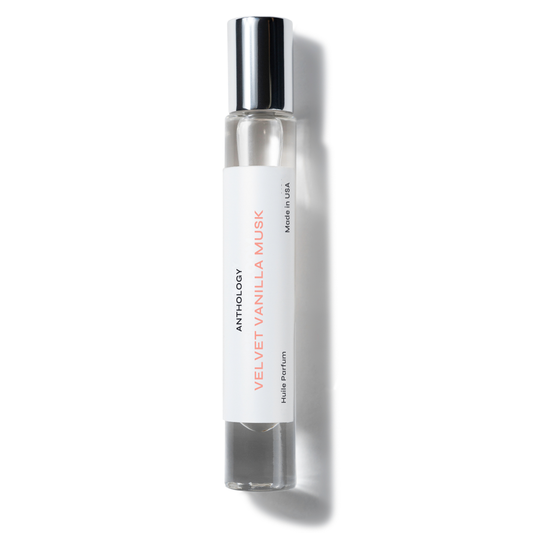
Musk is the invisible foundation of many of our most beloved compositions, providing the warmth, longevity, and skin-like intimacy that makes our oils perform so beautifully. Our Velvet Vanilla Musk Perfume Oil places musk at the very centre of its composition — a celebration of the note's warmth and softness, paired with vanilla to create something of extraordinary comfort and beauty.
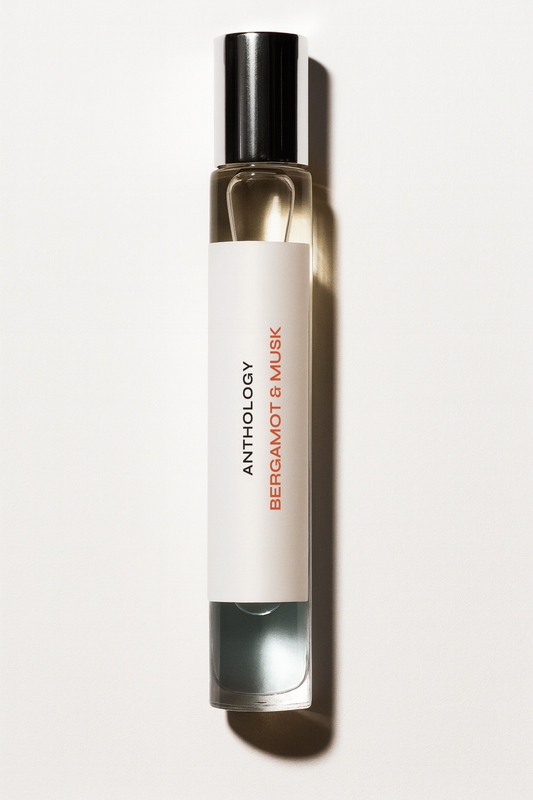
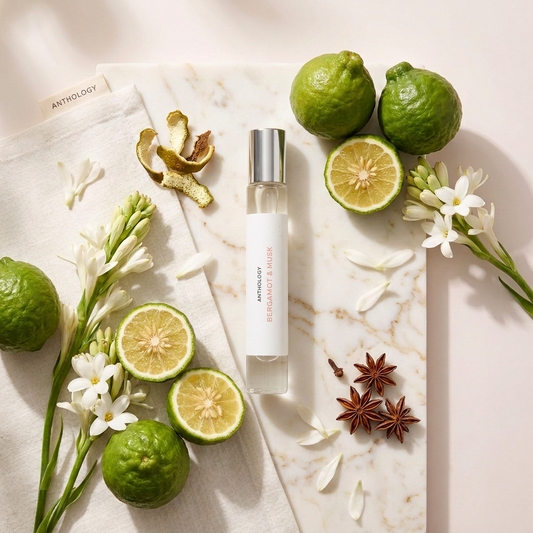
Our Bergamot & Musk Perfume Oil uses musk to ground and warm the brightness of bergamot, creating a composition that is simultaneously fresh and deeply intimate. And our Serene Bloom Perfume Oil uses white musk to give its floral heart a quality of clean, skin-close warmth that makes it feel like the most beautiful version of your own skin.
Explore our full Anthology Perfume Oils collection and feel the invisible note that makes everything better.