Note Deep Dive: Oud — The Liquid Gold of Perfumery
Anthology BeautyShare
No ingredient in the world of fragrance commands more reverence, more desire, or more extraordinary prices than oud. It is the most expensive natural fragrance ingredient on earth — genuine aged oud oil can cost more per gram than gold — and it has been at the centre of fragrance culture across the Middle East, South Asia, and Southeast Asia for over a thousand years. In the West, it arrived relatively recently and transformed fine perfumery in the process. This is the story of the ingredient that changed everything.
What Is Oud?
Oud — also known as agarwood, aloeswood, or oudh — is a resinous heartwood that forms inside the trunks of Aquilaria trees, a genus native to South and Southeast Asia. Under normal circumstances, Aquilaria wood is pale, light, and odourless. But when the tree is infected by a specific mould (Phialophora parasitica), it produces a dark, dense, extraordinarily fragrant resin as a defence mechanism. This infected heartwood is oud.
The infection process is rare, slow, and unpredictable. Only a small percentage of Aquilaria trees ever produce oud, and the finest oud comes from trees that have been infected for decades or even centuries. The rarity of the raw material, combined with the labour-intensive extraction process, is what makes genuine oud oil so extraordinarily expensive.
The Smell of Oud
Describing the smell of oud to someone who hasn't encountered it is one of perfumery's great challenges. It is simultaneously woody, smoky, animalic, sweet, leathery, and resinous — a complexity that seems to contain multitudes. It is warm but not sweet, dark but not heavy, ancient but not musty. It has a quality of depth that seems almost geological — as if it contains the memory of the forest it came from.
The character of oud varies enormously depending on its origin. Indian oud (Hindi oud) is typically the most animalic and barnyard-like — intensely complex and challenging, beloved by connoisseurs. Cambodian oud is sweeter and more approachable, with a fruity, almost floral quality. Indonesian oud tends to be earthier and more resinous. Malaysian oud is often described as the most balanced — woody, slightly sweet, and deeply complex without being overwhelming.
Oud in History and Culture
Oud has been burned as incense in religious ceremonies across Asia and the Middle East for over two thousand years. It appears in ancient Sanskrit texts, in the Bible (as 'aloes'), and in the Quran. In the Arab world, burning oud chips — known as bakhoor — is a deeply embedded cultural tradition, used to scent homes, clothing, and guests as an act of hospitality and generosity. In Japan, the ceremonial appreciation of oud incense — koh-do — is a refined art form with a history stretching back to the 15th century.
In Western fine perfumery, oud arrived as a significant presence in the early 2000s, when houses like Tom Ford, Montale, and later Maison Francis Kurkdjian began incorporating it into mainstream luxury fragrance. Its arrival transformed the market — introducing a new vocabulary of darkness, complexity, and depth that had been largely absent from Western perfumery.
Natural vs Synthetic Oud
The extraordinary cost of genuine oud oil has driven the development of synthetic oud molecules — laboratory-created compounds that capture aspects of oud's character without the expense or the sustainability concerns associated with wild Aquilaria harvesting. The most widely used synthetic oud molecules include Iso E Super (woody, cedar-like), Javanol (creamy, sandalwood-adjacent), and various proprietary agarwood accords developed by fragrance houses.
Synthetic oud is not inferior to natural oud — it is simply different. The best synthetic oud accords are extraordinarily beautiful and allow perfumers to create compositions that would be financially impossible with natural oud alone. Many of the most celebrated oud fragrances of the past two decades use a combination of natural and synthetic oud to achieve their character.
How Oud Behaves in a Fragrance
Oud is almost always a base note — its heavy, complex molecules evaporate slowly and provide extraordinary longevity and depth to any composition. It is one of the most powerful fixatives in perfumery, anchoring lighter notes and extending their life on skin dramatically. A fragrance with genuine oud in its base will typically last 10 to 14 hours or more.
Oud is also one of the most transformative ingredients in perfumery — it changes the character of everything around it. Rose with oud becomes darker and more passionate. Amber with oud becomes richer and more complex. Musk with oud becomes more animalic and intimate. It is an ingredient that elevates everything it touches.
Oud at Anthology
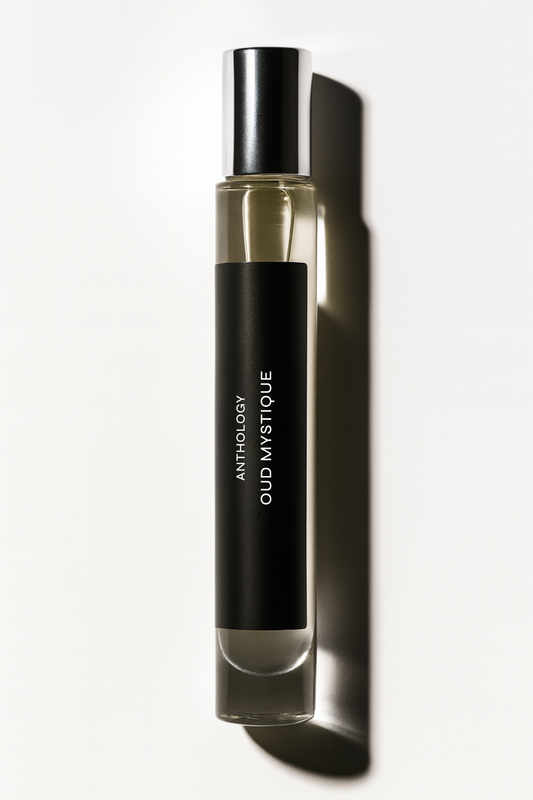
Our Oud Mystique Perfume Oil is our most complete expression of oud — a composition that places this extraordinary ingredient at its centre and allows its full complexity to unfold on skin over many hours. It is dark, resinous, and endlessly evolving — a fragrance for those who understand that true luxury has depth, mystery, and a little darkness.
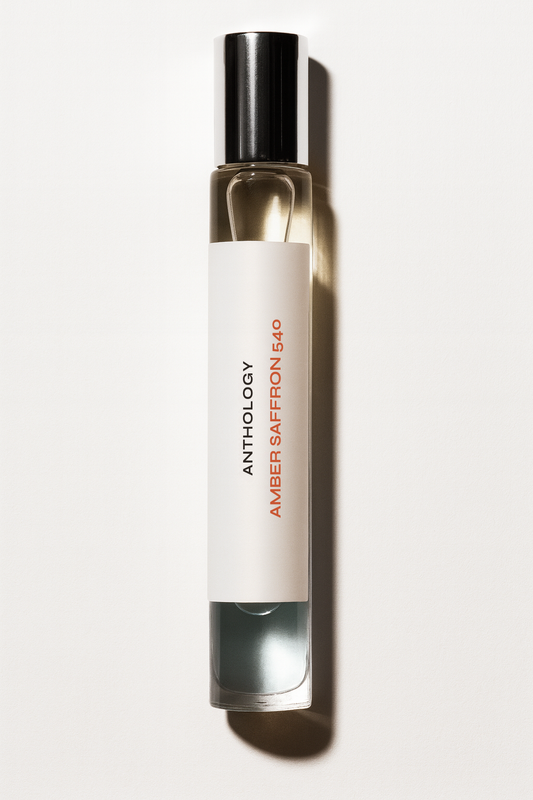
Oud's influence also runs through several of our other compositions as a supporting note, providing the depth and longevity that makes our oils perform so beautifully. Our Amber Saffron 540 Perfume Oil carries oud's warmth in its base, while our Rose on Fire Perfume Oil uses oud to give its passionate rose heart a dark, resinous depth that is deeply compelling.
Explore our full Anthology Perfume Oils collection and discover the ingredient that has captivated the world for a thousand years.