Note Deep Dive: Oud — The Most Precious Wood in Perfumery
Anthology BeautyShare
Oud is the most expensive natural aromatic material in the world. By weight, genuine oud oil commands prices that exceed gold — a kilogram of the finest Cambodian oud oil can sell for over $30,000 at wholesale, with exceptional pieces of oud wood fetching multiples of that. It has been treasured by Arab, Persian, Indian, Chinese, and Japanese cultures for over a thousand years as a sacred, ceremonial, and deeply personal aromatic material. And in the past two decades, it has conquered Western luxury perfumery with a completeness that no other ingredient has achieved in the modern era. This is the story of oud.
What Is Oud?
Oud (also known as agarwood, aloeswood, or oudh) is the resin-saturated heartwood of trees of the genus Aquilaria, found across South and Southeast Asia — primarily in Bangladesh, India, Vietnam, Cambodia, Laos, Indonesia, and Malaysia. In their healthy state, Aquilaria trees produce no aromatic material whatsoever. Oud is formed only when the tree is infected by a specific mould (Phialophora parasitica and related species) and responds by producing a dark, dense, extraordinarily fragrant resin as a defence mechanism.
The resin-saturated wood that results from this infection is agarwood — dense, dark, and of incomparable aromatic complexity. The longer the infection has been established and the more extensively the wood has been colonised by resin, the higher the quality and the higher the price of the resulting material. The finest agarwood — typically from old-growth wild Aquilaria trees in Cambodia and Vietnam — may have been developing its resin for decades or even centuries.
The rarity of genuine oud is extreme. Wild Aquilaria trees are now endangered in most of their natural range due to centuries of harvesting, and genuine wild oud is extraordinarily scarce. Most commercially available oud today comes from plantation-grown trees that have been artificially inoculated with the infection-causing mould — a process that produces oud of good quality but lacking the extraordinary complexity of wild-grown material.
The Smell of Oud
Genuine oud oil is one of the most complex aromatic materials available, containing hundreds of aroma compounds that interact to create a smell unlike anything else in the fragrance world. At its core, oud is woody — but it is a woodiness of extraordinary depth and facetedness, containing simultaneously warm and cool dimensions, sweet and animalic qualities, earthy and almost floral aspects. It has a richness and a quality of aliveness that synthetic oud approximations — however sophisticated — struggle to fully replicate.
The character of oud varies significantly by origin. Indian oud tends to be more animalic, slightly barnyard-like, and deeply intense. Cambodian oud is more refined and elegant, with a fruity-floral sweetness that is considered by many perfumers to be the finest expression of the note. Vietnamese oud has a distinctive green-woody quality with a slightly sweet, almost incense-like character. Indonesian and Malaysian oud tends to be earthier and more resinous, with a dark, slightly camphoraceous quality.
Oud in Traditional and Contemporary Perfumery
In the traditional perfumery of the Arab world, the Indian subcontinent, and East Asia, oud has occupied the summit of fragrance materials for over a millennium. It is burned as incense at religious ceremonies, applied to the skin and hair as a personal fragrance, and used as the defining ingredient in the most prestigious attars and mukhallats (traditional Arabic perfume blends). In these traditions, oud is not simply an ingredient — it is a statement of status, a mark of cultural sophistication, and a deeply personal expression of identity.
Oud entered mainstream Western luxury perfumery relatively recently — Tom Ford's Oud Wood in 2007 is often credited as the first major Western luxury house to bring oud to a broad Western audience — but its adoption has been extraordinarily rapid and comprehensive. Today, virtually every major luxury fragrance house has oud in its portfolio, and oud-adjacent molecules (synthetic oud-like materials such as Agarwood MD, Javanol, and various proprietary synthetics) are among the most widely used materials in contemporary fine fragrance.
Real Oud vs Synthetic Oud
The gulf between genuine natural oud oil and synthetic oud approximations is significant and immediately apparent to experienced noses. Natural oud has a complexity, a multi-dimensionality, and a quality of living warmth that synthetic alternatives — however cleverly constructed — cannot fully replicate. However, the best synthetic oud molecules capture important aspects of oud's character at a price point that makes them accessible, and many contemporary perfumers use them skillfully to create compositions that evoke the spirit of oud without the prohibitive cost of genuine natural oil.
The most sophisticated contemporary oud fragrances typically use a combination of natural oud oil and synthetic oud molecules — the natural providing the irreplaceable complexity of the real material, the synthetic extending it and adding consistency that natural oud alone cannot guarantee.
Oud at Anthology
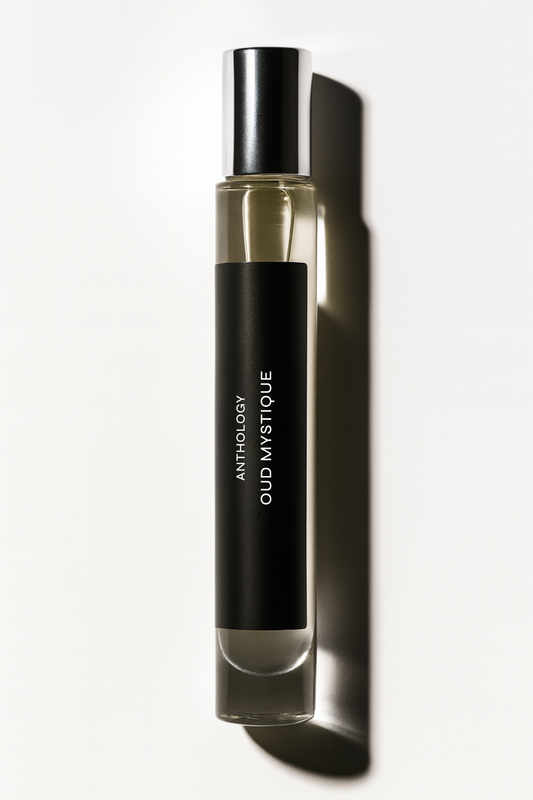
Our Oud Mystique Perfume Oil is our most complete and most ambitious oud composition — a deeply layered exploration of oud's extraordinary character, from its dark resinous opening through a complex heart of rose and saffron to a base of musk, amber, and vetiver that provides extraordinary longevity and depth. It is oud at its most beautiful and most considered.
Explore our full Anthology Perfume Oils collection and encounter the most precious wood in the world in all its dark, resinous, ancient glory.