Note Deep Dive: Vetiver — The Most Misunderstood Note in Perfumery
Anthology BeautyShare
Ask a casual fragrance wearer about vetiver and you'll likely get a blank look. Ask a perfume obsessive and their eyes will light up. Vetiver is one of the most complex, most versatile, and most beloved ingredients in all of fine perfumery — and yet it remains almost entirely unknown outside fragrance circles. This is its story.
What Is Vetiver?
Vetiver (Chrysopogon zizanioides) is a perennial grass native to India, now cultivated across tropical regions including Haiti, Indonesia, and Réunion. It is the roots of the plant — not the grass itself — that are used in perfumery. The roots are harvested, dried, and steam-distilled to produce vetiver essential oil: a thick, dark, intensely aromatic liquid that smells of earth, smoke, wood, and something almost indefinably complex.
The smell of vetiver is genuinely difficult to describe to someone who hasn't encountered it. It is earthy but not dirty. Smoky but not harsh. Woody but not sweet. It has a coolness to it — almost aquatic in some expressions — and a depth that seems to go on forever. It is one of the few fragrance ingredients that genuinely improves with age, both in the bottle and on skin.
The Chemistry of Vetiver
Vetiver oil is one of the most chemically complex ingredients in perfumery, containing over 150 identified compounds. The primary aroma molecules include khusimol (earthy, woody), vetiverol (smoky, rooty), and isovalencenol (the characteristic 'vetiver' quality that is almost impossible to describe but instantly recognisable). The precise composition of vetiver oil varies significantly depending on origin — Haitian vetiver is typically smokier and more earthy, while Indonesian vetiver tends to be cleaner and more woody, and Réunion vetiver sits somewhere between the two.
Vetiver's Role in Perfumery
Vetiver is almost always used as a base note — its heavy, complex molecules evaporate slowly and provide extraordinary longevity and depth to any composition. It is one of the great fixatives in perfumery, anchoring lighter notes and extending their life on skin. But vetiver is also increasingly used as a featured note in its own right — the star of compositions that celebrate its complexity rather than simply using it as a foundation.
It is a remarkably versatile ingredient. In a woody composition, it adds smokiness and depth. In a citrus fragrance, it provides an earthy counterpoint that makes the brightness feel more grounded and interesting. In a floral, it adds a green, slightly cool quality that prevents sweetness from becoming cloying. In an oriental, it deepens and enriches the base in ways that amber and musk alone cannot achieve.
The Great Vetiver Fragrances
Vetiver has inspired some of the most celebrated fragrances in history. Guerlain Vétiver (1961) is the archetype — a clean, elegant, slightly citrusy vetiver that defined the note for generations. Tom Ford Grey Vetiver brought it into the modern era with a polished, office-appropriate interpretation. Encre Noire by Lalique took it into darker, more austere territory. Each of these fragrances reveals a different facet of this endlessly complex ingredient.
Vetiver at Anthology
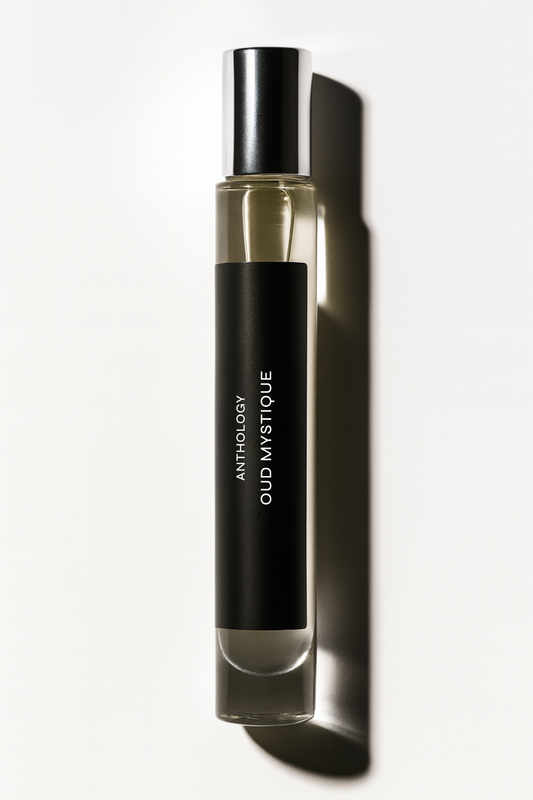
Vetiver's earthy, grounding quality appears as a supporting note in several of our most complex compositions, providing the depth and longevity that makes our oils perform so beautifully on skin. Our Oud Mystique Perfume Oil benefits from vetiver's smoky earthiness in its base, which gives the composition its extraordinary staying power and complexity. Our Bois De Santal Perfume Oil uses vetiver to add a dry, slightly smoky counterpoint to the creaminess of sandalwood — preventing sweetness and adding genuine depth.
For those drawn to the earthy, grounded world of vetiver, our Vanilla Woods Perfume Oil and Amber Gold both carry that same quality of rootedness and depth that makes vetiver-influenced fragrances so compelling and long-lasting.
Explore our full Anthology Perfume Oils collection and discover the quiet power of the world's most misunderstood note.