Note Deep Dive: Cardamom — The Queen of Spices
Anthology BeautyShare
Split a green cardamom pod with your thumbnail and the room changes. A cool, almost minty brightness rises first, then something warmer and resinous, a touch of lemon peel, a whisper of eucalyptus and a soft, floral sweetness underneath. It is a spice that smells cold and warm at once, and that paradox is exactly why perfumers love it. Cardamom has been called the Queen of Spices for centuries, and in modern perfumery it has quietly become one of the most useful notes on the perfumer's organ.
What Is Cardamom?
Green cardamom comes from Elettaria cardamomum, a tall, leafy perennial in the ginger family. The plant grows in the dappled shade of forest canopies, and its precious part sits surprisingly close to the ground: small flowering shoots creep along the soil and bear the pale green pods, each holding a cluster of sticky, dark brown-black seeds. Those seeds carry the aroma. Because every pod must be picked by hand, often across several harvests a year, cardamom is traditionally ranked among the costliest spices in the world, behind only saffron and vanilla.
It should not be confused with black cardamom (Amomum subulatum), a larger, smoke-dried pod with a camphoraceous, smouldering character. When a perfume lists simply "cardamom", it almost always means the green variety.
From the Cardamom Hills to the Highlands of Guatemala
Cardamom is native to the Western Ghats of southern India, where a range in Kerala is still known as the Cardamom Hills. It was traded westward in antiquity: Greek and Roman writers knew it, and the spice travelled the same caravan and sea routes as pepper and cinnamon. Across the Arab world it became inseparable from hospitality, ground with coffee to make qahwa, the fragrant, pale coffee poured for guests. Further north, it found an unlikely second home in Scandinavian kitchens, where cardamom buns remain a national comfort.
The most surprising chapter came in the twentieth century. Around 1914, a German coffee planter named Oscar Majus Klöffer is credited with introducing cardamom to the Alta Verapaz region of Guatemala. The cool, misty, shaded hillsides suited it perfectly, and Guatemala went on to become the world's largest producer and exporter. Much of its harvest still travels to the Middle East to flavour coffee, while a share is distilled for the fragrance industry. Today, perfumers often specify cardamom oil by origin, and Guatemalan cardamom is prized for its clean, fresh profile.
The Smell of Cardamom
Cardamom essential oil is produced by steam distilling the crushed seeds. Two molecules dominate its character. The first is 1,8-cineole (also called eucalyptol), which gives the cool, airy, faintly camphoraceous lift that makes cardamom feel fresh rather than fiery. The second is alpha-terpinyl acetate, a softer, sweeter, slightly floral and herbal ester that rounds the edges. Together they create a spice that sparkles instead of burns.
Smell a good cardamom oil on a blotter and you will notice several facets unfold: a bright, almost citrus opening; a green, aromatic coolness reminiscent of eucalyptus and bay; a gentle woody warmth; and, as it dries, a creamy, slightly sweet softness. Perfumers also use CO2 extracts, which capture more of the fresh, true-to-the-pod character of the spice. Unlike clove or cinnamon, cardamom rarely dominates. It illuminates.
Cardamom's Role in Perfumery
Because it straddles fresh and warm, cardamom is a natural bridge. In the top notes it adds lift and intrigue to citrus, making bergamot or bitter orange feel more sophisticated. Frédéric Malle's Cologne Bigarade, composed by Jean-Claude Ellena in 2001, pairs bitter orange with cardamom for exactly that effect. Ellena had already shown cardamom's daring side in Cartier's Déclaration (1998), where it sits beside cumin and woods in a celebrated masculine spice accord.
Cardamom is equally at home with woods. Its cool sparkle cuts through the creaminess of sandalwood and the dryness of cedar, which is why it opens Le Labo's Santal 33 (2011) alongside violet leaf. It flatters leather and suede, brightens oud and incense, and gives roses and iris a modern, almost peppery edge. In gourmand compositions it hints at chai, coffee and spiced pastries without tipping into sweetness. If you enjoyed our exploration of saffron, think of cardamom as its cooler, fresher sibling, and for a wider view of the spice family, see our guide to spicy versus warm fragrances.
Why Cardamom Suits Perfume Oil
Fresh top notes are notoriously fleeting in alcohol-based sprays, where the initial burst can evaporate within minutes. In a perfume oil, cardamom is held closer to the skin, so its bright, aromatic facets unfurl more slowly and blend gracefully into the heart of the fragrance. The result is a softer, more intimate spice: less of a flash, more of a glow. Applied to warm pulse points, a cardamom-led oil develops with the body's heat, revealing its creamy, woody undertones as the hours pass. It is a note that rewards the patience of the roll-on ritual.
Cardamom at Anthology
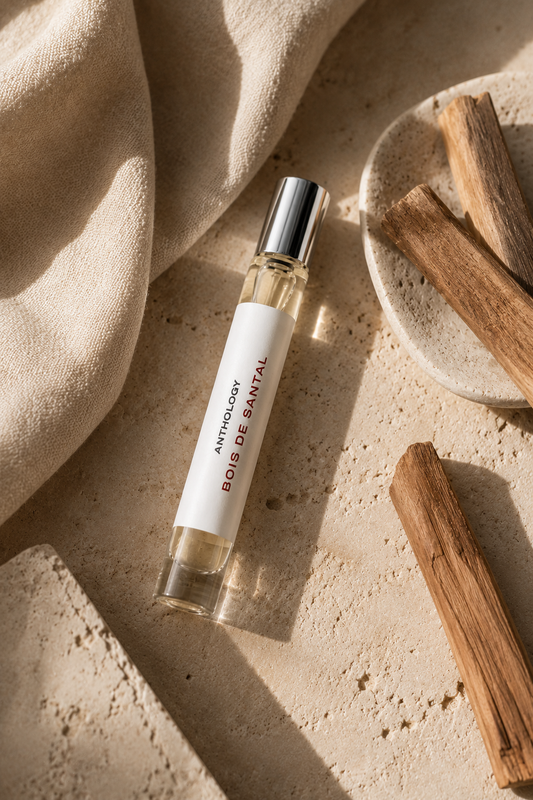
Bois de Santal Perfume Oil is our clearest cardamom statement. Bright cardamom opens alongside bergamot and a pinch of pink pepper, before creamy sandalwood, violet leaf and papyrus take centre stage over cedar, soft leather and musk. It is a textbook example of cardamom lightening a woody heart; read more about that partnership in our sandalwood deep dive.
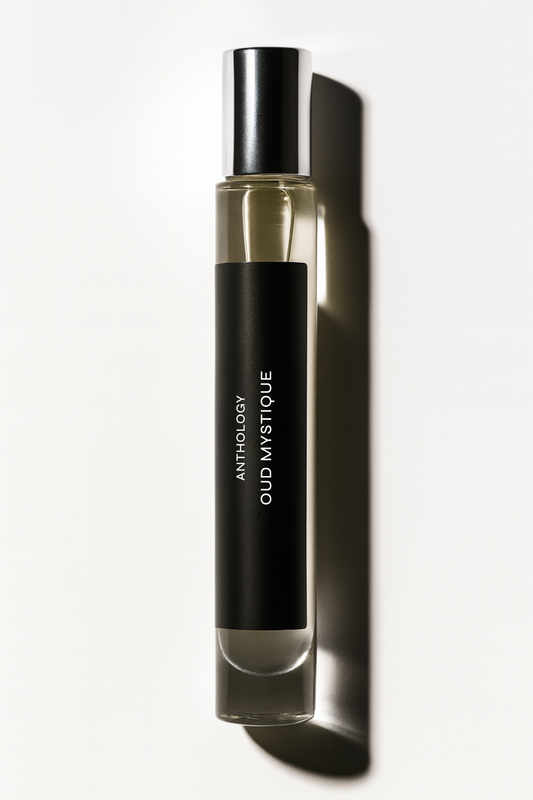
Oud Mystique Perfume Oil shows cardamom's warmer side. Exotic spices, a blend of cardamom and pepper, open onto rare oud wood and creamy vanilla, resting on amber, vetiver and sweet patchouli. Here cardamom acts as the gleam on dark wood, an ideal choice for evenings.
If you are drawn to cardamom's aromatic, spiced character, two more oils share its spirit. Dapper Secrets Perfume Oil pairs star anise, nutmeg and lavender with tonka bean, guaiac wood and tobacco, while Citrus & Cedarwood Perfume Oil layers lemon, grapefruit and bergamot over lavender, pink pepper, nutmeg and geranium, finishing on cedarwood, musk and incense.
And for those curious about one of the most famous cardamom openings in modern niche perfumery, we also carry samples of Le Labo Santal 33, with its top notes of violet leaves and cardamom over sandalwood, cedarwood and leather.
Cardamom is proof that a spice need not shout to be remembered. Discover more of our perfume oils in the Anthology Collection.