Note Deep Dive: Coffee — The Gourmand Note That Wakes Up a Fragrance
Anthology BeautyShare
There are few smells as instantly recognisable, or as universally loved, as freshly roasted coffee. It drifts out of cafés on cold mornings, fills kitchens before anyone is properly awake and clings to the air long after the cup is empty. Perfumers spent decades wrestling with it, because coffee is as fleeting as it is seductive. Yet once they learned to tame it, coffee became one of the most compelling notes in modern perfumery: dark, bitter, toasty and quietly addictive, the note that wakes up a sweet composition and gives it backbone.
What Is the Coffee Note?
In perfumery, "coffee" usually refers to the scent of roasted beans rather than the green, raw seed of the Coffea plant, which smells grassy and faintly beany. Perfumers work with natural coffee extracts — a solvent-extracted coffee absolute and, increasingly, a CO2 extract that captures a brighter, more faithful roasted aroma — alongside aroma molecules that rebuild the smell of a freshly ground bag. In practice, most coffee notes you meet in a fragrance are accords: careful reconstructions that combine naturals and synthetics to recreate the experience of coffee, from the first crack of the roast to the last creamy sip.
From Ethiopian Highlands to the Coffeehouse
Coffee's story begins in the highlands of Ethiopia, where Coffea arabica grows wild. The best-known legend tells of a goatherd named Kaldi who noticed his goats dancing with unusual energy after nibbling red berries from a particular shrub. It is a charming tale, though it was only written down in the late 17th century, long after coffee had already conquered much of the world.
What is better documented is that by the 15th century coffee was being brewed in Yemen, where Sufi communities drank it to stay alert through night-long devotions. From the port of Mocha it spread to Mecca, Cairo and Istanbul, where coffeehouses became famous as places of conversation, music and debate. By the 17th century coffeehouses had opened in Venice, London, Oxford and Paris. Few aromas carry such a sense of ritual, sociability and modern life.
The Smell of Coffee
Roasting transforms the coffee bean entirely. Through the Maillard reaction and caramelisation, sugars and amino acids recombine into hundreds of new aromatic compounds — chemists commonly cite more than 800 volatile molecules in roasted coffee. Among the most important is 2-furfurylthiol, a sulphurous molecule that, at tiny concentrations, smells unmistakably of freshly brewed coffee. Alongside it sit smoky, nutty pyrazines, caramel-sweet furanones and spicy guaiacols.
The result is a note with many facets: roasted and toasty, like bread crust or toasted nuts; bitter and dark, close to cocoa and burnt sugar; smoky, with a whisper of tar or tobacco; and, depending on the accord, creamy and milky when perfumers soften it with lactonic notes. A good coffee accord can lean toward an espresso shot, a milky latte or a sticky café liqueur.
That same complexity is why coffee is so hard to capture. The aroma of freshly ground beans fades within minutes, and some of its most important molecules are unstable. It is also why so many people associate coffee with "resetting" the nose — though, as we explain in our guide Why Do I Stop Smelling My Own Perfume?, the famous jar of coffee beans at the perfume counter works no better than fresh air.
Coffee's Role in Perfumery
Coffee entered mainstream perfumery alongside the gourmand family. In 1992, Thierry Mugler's Angel showed that edible notes could be glamorous; four years later, A*Men (1996), created by Jacques Huclier, brought a bold coffee note into men's fragrance, pairing it with patchouli, tar-like smoky facets and sweet tonka. It proved so distinctive that Mugler later released A*Men Pure Coffee (2008), devoted to the note. You can read more about its predecessor in our profile Thierry Mugler Angel: The Fragrance That Invented Gourmand.
In 2014, YSL's Black Opium carried coffee to an even wider audience, wrapping a coffee accord in white florals and vanilla. Since then, coffee has become a staple of modern gourmands and ambers, prized because it does something sweet notes cannot do alone: it adds bitterness, contrast and adult sophistication.
Coffee pairs beautifully with:
Vanilla and tonka — the classic café-crème pairing, where coffee's bitterness keeps sweetness in check. Cocoa and praline — for a mocha effect, rich and indulgent. Spices such as cardamom, cinnamon and saffron, echoing spiced Arabic and Turkish coffee traditions. Leather, tobacco and smoky woods, which amplify its roasted, darker side. White florals like jasmine and orange blossom, whose creamy sweetness turns coffee seductive. Boozy notes such as cognac and rum, evoking an after-dinner digestif. For more on the family coffee belongs to, see What Are Gourmand Fragrances and Are They for Me?
Why Coffee Shines in Perfume Oil
Coffee is a note of warmth and closeness, and perfume oil suits it perfectly. Without alcohol to flash off the top notes, the roasted opening settles gently into the skin, and the coffee facet reveals itself slowly as the composition warms. Oils also stay close to the body, so a coffee-gourmand feels intimate and inviting rather than cloying — the scent of someone who has just stepped out of a cosy café, not the café itself. A dab at the wrists and the base of the throat is all you need, especially on autumn and winter evenings.
Coffee at Anthology
Vanilla Woods Perfume Oil is our richest coffee composition: smoky vanilla wrapped in warm spice and dark resinous tones, unfolding into creamy florals and roasted coffee nuances over suede-like woods, with notes of vanilla, saffron, coriander, plum, coffee, leather and smoky woods. It is coffee at its most decadent and nocturnal.
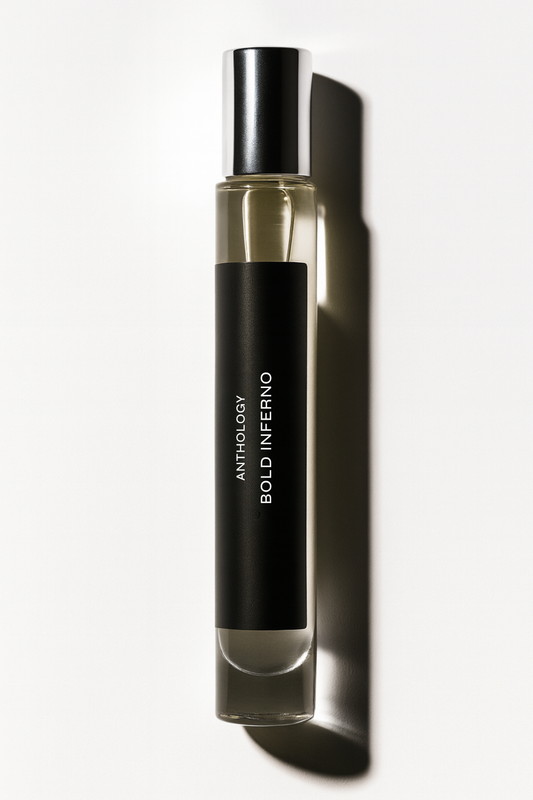
Ambery Grapefruit "Bold Inferno" Perfume Oil shows coffee's fresher, more surprising side. Red grapefruit and cranberry open brightly before a heart of saffron and lavender, settling onto a base of red cedarwood, amber and rich coffee — proof that the note can add depth to an energetic, ambery scent.
For a coffee-friendly partner, Angels' Elixir Perfume Oil brings golden cognac, cinnamon, oak and tonka bean with a praline and vanilla dry-down — wear it alongside Vanilla Woods for a spiced café-liqueur effect. Velvet Vanilla Musk Perfume Oil, layered under Bold Inferno, softens the coffee into something closer to a latte.
If you'd like to explore coffee in a spray, we also carry d'Annam Vietnamese Coffee, a tribute to cà phê sữa đá with notes of coffee, dark chocolate, condensed milk, lily-of-the-valley, tonka bean, amber and cedarwood, and Vanilla White Flowers, which pairs coffee and vanilla with pear, jasmine, orange blossom and patchouli.
Whether you take yours as a dark espresso or a sweet, creamy latte, coffee is the note that makes a fragrance feel awake. Discover more rich, long-lasting compositions in the Anthology Collection.