Note Deep Dive: Tobacco — Smoke, Honey and Nostalgia
Vandana MagnaniShare
There is a particular smell that lives in old libraries, in the lining of a grandfather's tweed jacket, in a cedar humidor opened after a long dinner. It is sweet but dry, golden but faintly smoky, like honey spread on hay and left in the late-afternoon sun. That smell is tobacco leaf, and in perfumery, where it never has to be lit, it is one of the most comforting and nostalgic notes there is.
What Is Tobacco in Perfumery?
The tobacco note in a fragrance has almost nothing to do with cigarette smoke. It is the scent of the cured leaf of Nicotiana tabacum, the broad-leaved plant first cultivated in the Americas. After harvest, the leaves are hung and dried slowly, and during this curing they turn from green to gold and brown, developing the rich, sweet aroma that perfumers prize. That aroma can be captured as a tobacco absolute, a thick, dark extract made by solvent extraction, or rebuilt from scratch as an accord using other materials. Most modern tobacco fragrances use a combination of the two.
From the New World to the French Court
Tobacco reached Europe in the sixteenth century, and its story in France is tied to one man. Around 1560, Jean Nicot, the French ambassador to Portugal, sent tobacco to the French court, where, so the story goes, it was offered to Catherine de' Medici as a remedy for headaches. The plant became fashionable almost overnight, and Nicot's name was later immortalised in the botanical genus Nicotiana, and in the word nicotine.
Perfumery adopted the smell of tobacco much later, and it took a modern woman to do it. In 1919, Ernest Daltroff of the house of Caron created Tabac Blond, a fragrance said to have been inspired by the women of post-war Paris who had begun to smoke openly. Rather than hide the smell of tobacco with flowers, Daltroff turned the scent of blond leaf and leather into something glamorous and daring. Tabac Blond remains one of the founding texts of leather and tobacco perfumery, and it opened the door for every honeyed, smoky tobacco fragrance that followed.
The Smell of Tobacco
Good tobacco is remarkably complex. Its key facets include:
Honey and hay. Cured leaf has a sweet, sun-dried warmth, somewhere between beeswax and a freshly baled field. Much of this comes from a family of aroma molecules called megastigmatrienones, sometimes known by the trade name tabanone, which are formed as the leaf cures.
Dried fruit. Many tobacco absolutes carry a soft note of raisin, prune or dried apricot, helped by molecules such as damascenone, which also appears in rose and in cooked fruit.
Leather and wood. Darker tobaccos lean towards leather, cedar and a faint earthiness, which is why tobacco sits so naturally in leathery and woody compositions.
A whisper of smoke. In a fine fragrance, smoke is a nuance rather than an ashtray: think pipe tobacco in a closed pouch, not a burning cigarette.
Tobacco's Role in Perfumery
Tobacco is a social note; it rarely appears alone. Its classic partners include tonka bean and vanilla, which amplify its sweetness (tonka has long been used to flavour pipe tobacco itself); lavender and bergamot, the backbone of the barbershop fougère; boozy notes such as rum, cognac and whisky; spices such as cinnamon, clove and star anise; and leather, suede and woods for depth. Serge Lutens' Chergui (2001) wrapped tobacco leaf in honey, hay and incense, while Tom Ford's Tobacco Vanille (2007) paired it with vanilla, tonka and cocoa so memorably that it has become a modern reference. We will explore that fragrance in depth in its own profile.
Because tobacco is a warm base note, it suits autumn and winter beautifully, and it is equally at home in fragrances worn by men and women. A touch adds gravitas to a floral; a generous dose turns a gourmand into something altogether more grown up.
Why Tobacco Suits Perfume Oil
Tobacco is a note that rewards closeness. Its honeyed, hay-like richness is at its best when it sits near the skin rather than projecting across a room, and that is exactly how a perfume oil behaves. Without alcohol to flash off the top notes, an oil lets the warm base unfold slowly and evenly over the course of the day, and the skin's own warmth draws out tobacco's sweetness. A single stroke on the wrist or at the base of the throat is all it takes to create that intimate, armchair-by-the-fire impression.
Tobacco at Anthology
If you want tobacco itself, start with Dapper Secrets. Bergamot and lemon open onto a heart of star anise, nutmeg and lavender before a base of tonka bean, guaiac wood and sensuous tobacco settles in: a polished, barbershop-meets-library take on the note.
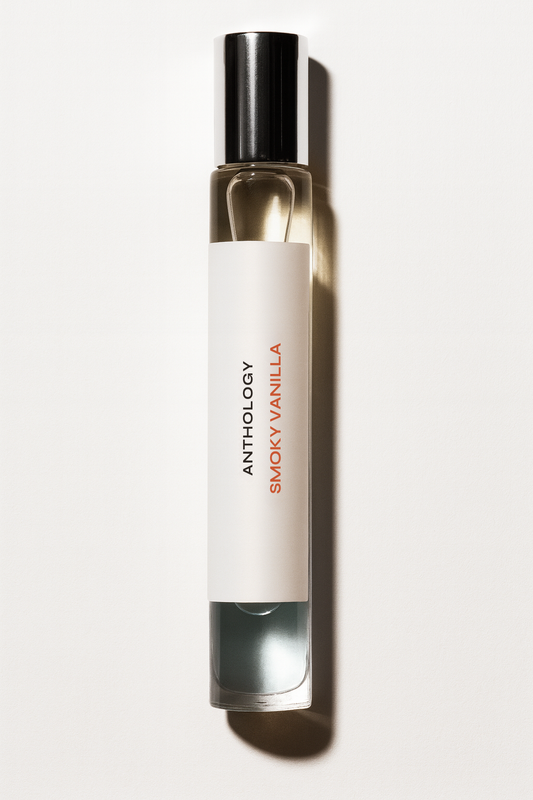
To build the classic tobacco partners around it, try Angels' Elixir, a golden cognac note with cinnamon, oak wood and tonka over praline and vanilla, or Smoky Vanilla, where black pepper, vanilla absolute, suede, amber, incense and cedarwood create the soft-smoke atmosphere that tobacco loves. Vanilla Woods brings coffee, plum, leather and smoky woods for an after-dinner mood, and Amber Soir offers rich resins, vanilla and warm tonka. Layer Dapper Secrets with either Angels' Elixir or Amber Soir for a richer, warmer tobacco effect.
For tobacco lovers exploring designer and niche fragrances, our store also carries samples of Le Labo Tabac 28, built around tobacco absolute, oud and cedarwood, and Initio Side Effect, which pairs tobacco with vanilla, rum and cinnamon.
Curious about tobacco's closest companions? Read our Note Deep Dive on tonka bean, discover what makes a leather fragrance, and find more cold-weather favourites in the best perfume oils for winter.
Smoke, honey and nostalgia, without a single flame. Explore the full Anthology Collection and find the warm, golden scent that feels like coming home.