Note Deep Dive: Osmanthus — The Apricot-Scented Flower of the East
Anthology BeautyShare
Walk through a southern Chinese town in October and you may smell it before you see it: a warm, honeyed sweetness drifting over the pavements, like apricots left to ripen in the sun. Look up and there is nothing showy to explain it, just an evergreen tree studded with clusters of tiny gold or cream flowers. This is osmanthus, the autumn flower of China and Japan, and one of the most quietly seductive materials in perfumery.
What Is Osmanthus?
Osmanthus fragrans is an evergreen shrub or small tree, native to East Asia from the eastern Himalayas through southern China and into Japan. In English it goes by fragrant olive, tea olive or sweet olive; in China it is guìhuā; in Japan it is kinmokusei, the name usually given to its orange-flowered form. The blossoms are tiny, barely a few millimetres across, and they appear in a short, intense burst between September and November. For a few weeks the scent seems to hang over whole neighbourhoods, and then it is gone until the following autumn.
A Flower Woven Into Chinese Life
Osmanthus has been cultivated in China for more than 2,500 years and was planted in the imperial gardens of the Forbidden City. Its presence in the culture is everywhere. The southern city of Guilin takes its name from the tree: 桂林 means, quite literally, "osmanthus forest". At the Mid-Autumn Festival, families eat osmanthus-scented cakes and drink osmanthus wine under the full moon, and folklore tells of Wu Gang, condemned to chop forever at an osmanthus tree on the moon that heals itself after every blow.
The flowers are also a kitchen ingredient: steamed with rock sugar and pears in China, folded into jams and cakes in Japan, and blended into some of China's loveliest scented teas. In Japan, kinmokusei is the smell of autumn itself, tied to school festivals and a wistful, nostalgic mood as the weather turns cool.
From Branch to Absolute
Osmanthus is too delicate for steam distillation to do it justice, so perfumers work with an absolute. Givaudan describes the traditional process: the flowers are harvested by beating the branches with long sticks so the blossoms fall onto cloths below, then preserved in brine for a few weeks, which develops the precursors of their scent. The flowers are extracted with a volatile solvent to make a waxy concrete, which is then washed with alcohol to produce the absolute. Ageing the concrete deepens its tea-like notes. Vast quantities of flowers are needed for a small amount of material, which is why true osmanthus absolute is among the more precious ingredients on a perfumer's shelf.
The Smell of Osmanthus
Ask a perfumer to describe osmanthus and you will hear the same words again and again: apricot, leather, tea. The fruitiness comes first, a ripe, velvety apricot and peach effect that chemists link to lactones, the same family of molecules behind the creaminess of stone fruit. Alongside it sit ionones, which lend a soft violet and woody glow, and a floral sweetness reminiscent of jasmine. Underneath, the absolute carries a supple, suede-like leather facet, developed during the brine stage, and a dry, smoky nuance often compared to black tea leaves.
That combination is what makes osmanthus so special. It is a floral that does not feel like a bouquet; a fruit note that does not feel like a sweet; a leathery material that never turns harsh. It sits somewhere between the orchard, the tea house and a well-worn suede glove.
Osmanthus's Role in Perfumery
Because of its many facets, osmanthus works as a bridge. With jasmine and other white flowers it adds sun-warmed fruit; with tea and citrus it becomes airy and contemplative; with leather and smoke it gains a polished, golden richness. Perfumers also use it to round out apricot, peach and cherry accords so they read as natural rather than candied.
Jean-Claude Ellena, the master of transparency profiled in our Terre d'Hermès feature, has returned to it more than once. His Osmanthus for The Different Company (2001) paired the flower with bergamot, mandarin, hay and musk, and his Hermessence Osmanthe Yunnan for Hermès (2005), named after the Chinese tea-growing province, set osmanthus and apricot against dry black tea and orange. Elsewhere it has been used to amplify jasmine, to shade a pear with candied violet, or, as in our Zoologist profile, to open the bamboo-and-tea world of Panda.
Why Osmanthus Suits Perfume Oil
Osmanthus is a skin note. Its apricot and suede facets are soft rather than loud, and in an alcohol spray the brightest parts can flash off quickly, leaving the heart a little thin. In an oil base the material unfolds slowly and stays close, warming with the skin so the fruit, tea and leather emerge in turn over hours rather than minutes. Apply to the inner wrists and the base of the throat, and let it bloom; it is a scent that rewards those who lean in.
Osmanthus at Anthology
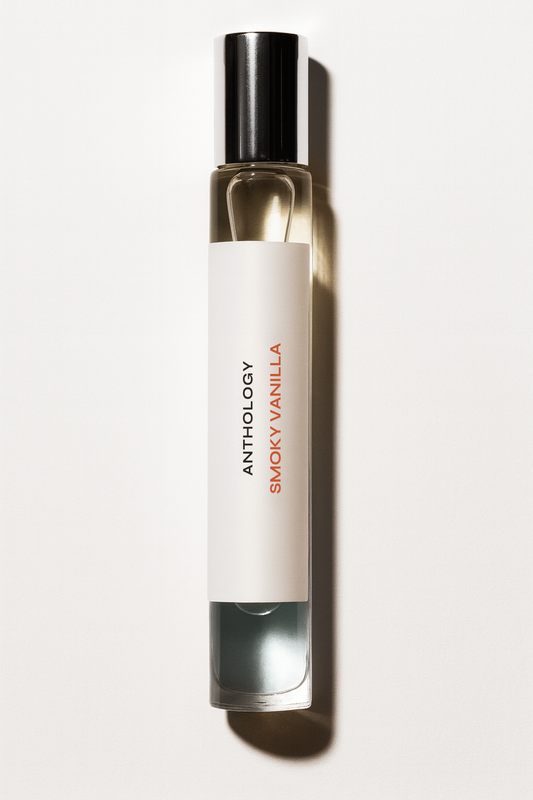
Cherry on Top Perfume Oil places osmanthus at its heart alongside jasmine sambac, framed by juicy Morello cherry and sparkling ginger, and settles onto ambrettolide and pink peppercorn: a modern way to experience the flower's fruity side. For its tea-house mood, Citrus Matcha Perfume Oil pairs matcha and citrus with a soft fig heart over vetiver and cedarwood, while Whispering Petals Perfume Oil opens with green tea and bergamot before a heart of jasmine, rose and orchid. To echo osmanthus's apricot glow, Chilly Pacific Perfume Oil brings blackcurrant, citron, orange and apricot, and for the suede facet, layer with Smoky Vanilla Perfume Oil, with its vanilla, suede and amber.
If you would like to smell osmanthus in the hands of luxury houses, our curated designer selection includes Creed Queen of Silk, which opens on osmanthus, magnolia and saffron, and Tom Ford Cherry Smoke, where Chinese osmanthus and apricot sit between sour cherry and smoked woods. For more on the house behind Queen of Silk, read The House of Creed, and to meet osmanthus's closest floral partner, see our Jasmine Note Deep Dive.
Discover the full range of fruit, floral and tea-kissed perfume oils in the Anthology Collection.